
Terrible Lizards Movement Guide: Run, Slide and Wall Run
How Terrible Lizards movement works: aerial control, wall runs, slides, mantles, swings and bounces, with the timing that keeps chases from ending in a fall.
Terrible Lizards has no attack button. Every problem is solved by moving: running past a dinosaur, sliding under a closing door, wall running over a flooded gap, or swinging across a room that has no floor. The game calls itself a parkour platformer, and that is literal. The movement is the combat system.
The good news is that the movement is forgiving. Aerial control is strong, mantles are generous, and checkpoints are frequent. The bad news is that the game rarely explains the timing. This guide covers the verbs, the order you learn them, and the mistakes that make a chase feel unfair.
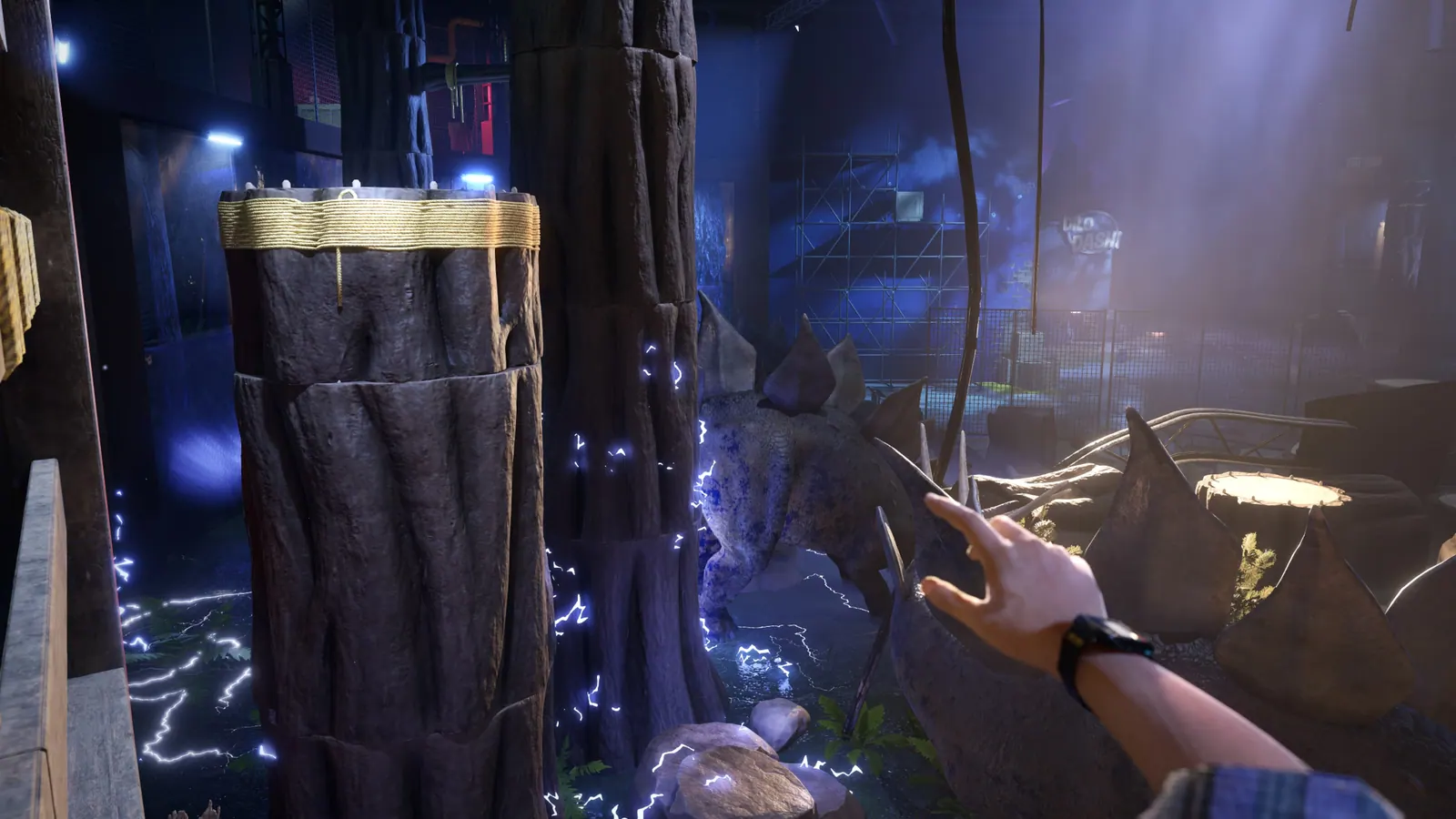
Run with momentum, jump early and steer in the air, slide into gaps instead of jumping, aim for the lip of a ledge to mantle, jump at a wall at an angle to wall run, and release swings at the top of the arc. The game rewards chaining verbs without stopping, not perfect individual inputs.
The movement verbs
Run and sprint
Sprint is the fast state, and it is the one the levels are built around. The game does not have a stamina bar, so you can hold sprint indefinitely. The important detail is momentum: a sprinting jump covers more distance than a standing jump, and the game's gaps are sized around that difference.
When you enter a new room, look for the path that lets you keep your speed. A route that requires a standing jump is usually the wrong route. Patch 1.0.9 fixed a controller bug that could leave sprint stuck off, so if your run suddenly feels slow, check for an update.
Jump and aerial control
The jump has a fixed maximum height, but the air control is unusually strong. After takeoff, you can steer left and right, and you can adjust your forward speed. This is the game's main safety net. If you jump too early, steer forward; if you jump too late, pull back.
The jump is a single input. There is no double jump, and the game expects you to use the mantle when a jump comes up short.
Slide
The slide is a low-profile move that lets you pass under obstacles and maintain momentum. It is essential in chases, where a narrow gap is often the only escape.
The slide has a recovery period. Do not slide in open space unless you are trying to avoid a high attack or pass under a barrier. Slide into a gap, then stand up and keep running.
Mantle and ledge grab
When you jump toward a ledge that is slightly too high, Jordan grabs it and pulls up. The mantle is one of the most forgiving parts of the movement system. It works from a range of angles, and it does not require a precise input.
The mistake is aiming at the wall instead of the ledge. Aim for the top edge. If you are falling, steer toward the ledge; the grab can save a jump that looked doomed.
Wall run
Wall running is the signature move. Yellow paint or yellow lights mark a runnable surface. Jump toward the wall at an angle, then run along it. The game does not require a perfectly perpendicular approach; a diagonal approach is usually better because it gives you an exit angle.
The hard part is the exit. Look for the next platform before you start the run. If you run out of wall without a plan, you will fall. Release the wall when the next platform is in front of you, not when the wall ends.
Swing
Swings come in several forms: horizontal bars, crane hooks, hanging platforms, and gondola cables. Grab the bar at the low point of its arc, then release at the top. Releasing early loses distance; releasing late can overshoot.
After release, you still have air control. Use it to steer toward the landing. The swing itself is forgiving; the landing is where most players fail.
Bounce
The yellow goo is a trampoline. Jump onto it to launch higher than a normal jump. Some goo patches only appear after you press a button, which turns the room into a timing puzzle: press the button, watch where the goo appears, then plan the route before you commit.
The goo also appears in combat spaces. In Chapter 4, a goo patch over a red void is a required traversal, not an optional shortcut.
How the verbs chain
The game's best routes chain verbs in a specific order: run, jump, wall run, jump, mantle, slide. Each verb preserves some momentum, and the transitions are where the skill ceiling lives.
A simple example is a wall run into a ledge. You jump at the wall, run along it, jump off at the end, and grab a ledge that would be too high from the ground. If you stop after the wall run, you lose the height. If you jump too early, you miss the ledge.
The same logic applies to swings. A swing into a wall run into a mantle is a common Chapter 3 sequence. The individual moves are easy; the chain is the challenge.
Movement in chases
Chases change the priorities. You are not trying to find the shortest path; you are trying to find the path that does not require a stop.
- Do not look back. The dinosaur is behind you. The route is in front.
- Follow the yellow lights. They mark the intended escape route.
- Slide into gaps, do not jump over them. A slide keeps you low and fast.
- Use height. A ledge or a wall run puts distance between you and the animal.
- Do not fight the camera. The game's chase cameras are designed to show the route, not the creature.
The first Brontosaurus chase in Chapter 1 is a scripted introduction. The Chapter 2 arena is a real test. The Chapter 3 Allosaurus chases are the hardest because the routes have multiple levels and the animal can cut through rooms.
The best places to practice
- Chapter 1 lobby. The Brontosaurus tail is a safe place to practice mantling and short jumps.
- Chapter 2 crane. The crane swing is a forgiving swing-to-ledge sequence.
- Chapter 3 wall-run corridor. The red-lit wall run is the best place to learn the exit timing.
- Chapter 4 ascent. The two-minute climb is the final exam: wall runs, mantles, swings, and a moving structure.
If you are struggling with a specific move, replay the chapter with level select. The game does not punish practice.
Common movement mistakes
- Jumping from a standstill. Build speed first. A standing jump is shorter and harder to steer.
- Sliding too early. The slide has a recovery period. If you slide before a gap, you may not have time to stand up and jump.
- Aiming at the wall. For a mantle, aim at the ledge. For a wall run, aim at the wall at an angle, not straight on.
- Releasing the swing too early. Wait for the top of the arc. The extra height is the point.
- Ignoring the yellow paint. The game uses yellow consistently. If a surface is yellow, it is probably interactive.
- Trying to fight. There is no combat. Running toward a dinosaur is never the answer.
Does the game have advanced tech?
The movement has a high skill ceiling, but the advanced tech is mostly about momentum conservation rather than glitches. Players have found shortcuts that skip sections of a room, but the game's scripted sequences and locked doors limit how much you can break.
The speedrun guide covers the route logic and the shortcuts worth learning. It does not claim a world record. The game is new, and the route is still being optimized.
FAQ
Is there a sprint button? Yes. Sprint is a separate input, and the game has no stamina bar. Patch 1.0.9 fixed a controller bug that could make sprint stop working.
Can you jump in midair? No. You get one jump, but you have strong air control and a generous mantle.
How do you wall run? Jump at a yellow-marked wall at an angle, then run along it. Exit when the next platform is in front of you.
Can you climb any wall? No. Only yellow-marked surfaces and specific ledges are climbable. The rest is background.
Does the game have a slide jump? There is no dedicated slide-jump move. You can jump after a slide once the recovery ends, but the game treats the two as separate verbs.
Is the movement hard to learn? The basics are easy. The skill ceiling is high, but the story does not require advanced tech.
What to read next
The beginner guide covers the first hour and the order you learn the verbs. The chase sequences guide applies the movement to each encounter. The bosses guide covers the Brontosaurus, Allosaurus, and the final Hybrid.
For the full route, start with the walkthrough. For a faster run, read the speedrun guide.
Sources
- Terrible Lizards on Steam — official description and feature list.
- PlayStation Blog developer interview — John Gelardi on aerial control, momentum, and the movement references.
- Xbox Wire: Movement Is Your Weapon — the no-combat design and the low skill floor.
- Terrible Lizards official site — premise and setting.
Official source: Terrible Lizards on Steam — release date, price, platforms, and patch notes.
More Terrible Lizards Guides
Every creature in Terrible Lizards: the Brontosaurus, Allosaurus, Dilophosaurus Hybrid, and the Paleo Pal mascots, with chapters, behavior, and survival tips.
Every major Terrible Lizards encounter, from the Brontosaurus hunts to the Allosaurus fuse chase and the final Hybrid, with the route that ends each fight.
A complete route through Dalton's Dinos: the 9216 box office keypad, the Brontosaurus tail Amber, the fuse basement, and the first stuffed animal.
The Digsites route: generator order, the 0451 tower code, the 1677 lift, the 0180 dynamite locker, and the Brontosaurus hunt.
Rail and Freight Caverns route: goo launch pads, the Allosaurus stare, the freight platform puzzle, and all four fuse locations.
The Deep route: DJ's Allosaurus tooth, the special-spectrum lights, Cavern A dynamite, the Crew Lift Key, and the two-minute Dennis chase.
Who Dennis is in Terrible Lizards: DJ's imaginary friend, the Paleo Pal mascot, and the creature in the lair, plus the story clues that connect them.
What happens at the end of Terrible Lizards: the crew lift escape, Dennis's fate, the black material, the bonus scene, and the sequel hook.